Perp DEX cost on ETH: $1k vs $1M by venue
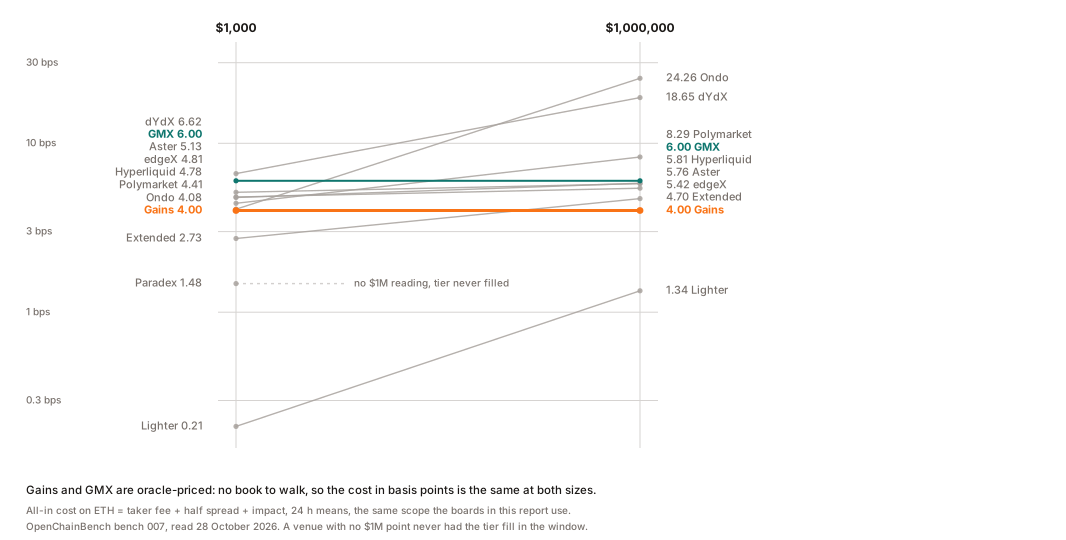
Lighter is cheapest at both sizes on ETH as of 28 October 2026: 0.21 bps at $1,000 and 1.34 at $1,000,000. Behind it the ranking is rebuilt.
Key finding
As of 28 October 2026, Lighter is the cheapest of eleven perp venues on ETH at both sizes: 0.21 bps all-in at $1,000 notional and 1.34 bps at $1,000,000. Behind it the ranking is rebuilt. Gains climbs from fourth to second without its number moving, 4.00 bps at both, and Paradex, second cheapest at $1,000, produces no $1,000,000 reading at all.
Perp DEX cost at $1,000 and $1,000,000 notional
As of 28 October 2026. Every figure in the prose is an ETH 24-hour mean, the same scope the boards embedded below use. The boards are live and move on their own; the prose does not.
Every comparison of perpetual DEXes we have seen ranks venues on one number. That number is a price at one trade size, and most of the ranking it produces does not survive a change of size.
At $1,000 notional the field runs from Lighter at 0.21 basis points to dYdX at 6.62, a factor of 31, and it is almost entirely a fee-schedule story: Lighter charges no taker fee, dYdX charges five basis points at tier zero.
Step the same measurement to $1,000,000 and it is no longer about fee schedules at all. Ondo's all-in cost multiplies by 5.9 and dYdX's by 2.8; Lighter, cheapest at both, multiplies by 6.4. Hyperliquid, which runs the deepest decentralised book we measure, pays 1.2 times more at the larger size. Two smaller books hold up better: Aster rises 1.12 times and edgeX 1.13, and both filled every probe.
One venue simply stops. Paradex is the second cheapest place to open a $1,000 ETH perp, at 1.48 bps, and produced no $1,000,000 reading in the window at all: the visible book never absorbed the tier, so the harness counted the skip instead of extrapolating a price nobody could have traded. An absent number is the honest result there, and it is more useful than a cheap one at a size you cannot get.
Two lines on that chart are flat. Gains and GMX charge exactly what they charged at a thousandth of the size.
Oracle venues and order books: two cost machines
The flat lines are not a trading result. They are what an oracle-priced venue is.
On an order book venue, the price you get is the price resting in the book, and a larger order consumes more of it. The cost of size is the shape of the book, which is why the slope of each line is a depth measurement in disguise. On an oracle-priced venue there is no book: the venue quotes a price from an external feed and takes the other side from a shared collateral pool, charging a flat percentage of notional. A thousand dollars and a million dollars cost the same in basis points because the mechanism does not know the difference.
We publish that ratio directly as cost slope, the all-in cost at $1,000,000 divided by the all-in cost at $1,000.
| # | Provider | p50 (x) | Success |
|---|---|---|---|
| 1 | 1.000x | 100.0% | |
| 2 | 1.000x | 92.8% | |
| 3 | 1.136x | 100.0% | |
| 4 | 1.152x | 100.0% | |
| 5 | 1.170x | 100.0% | |
| 6 | 1.943x | 99.0% | |
| 7 | 2.69x | 100.0% | |
| 8 | 5.58x | 99.7% |

Cost slope by venue, 24h averages. A venue whose cost does not change with size scores 1.00.
Gains and GMX score 1.00 by construction, and the board's own methodology says so rather than letting the ranking imply a performance win. Among venues that do have a book the order is worth reading slowly: Aster at 1.12 and edgeX at 1.13 sit below Hyperliquid at 1.22, which carries a far deeper book than either. Slope is not depth. It is what a $1M order pays over a $1k one, and a smaller book whose $1M tier still fills can hold its price better than a large one being asked for a hundred times more.
That distinction matters for how the rest of this report should be read. The two models are not competing on one axis. They are different machines that happen to sell a similar product, and the benchmarks separate where each one wins.
Where oracle pricing is cheaper
Cost that does not move with size
At $1,000,000, Gains is the second cheapest venue measured, at 4.00 basis points. Only Lighter is cheaper, at 1.34.
What is unusual is not the rank, it is that the number did not move. Gains charged 4.00 bps at a thousand dollars and 4.00 at a million. Extended sat below it at $1,000, at 2.73 bps, and is above it at $1,000,000, at 4.70. Paradex sat below it too, at 1.48, and has no $1,000,000 reading at all. Gains did nothing in either case.
A second column is worth reading next to the cost, though it settles nothing about price. The harness records whether the $1,000,000 probe actually completed: when the visible book cannot absorb the order it skips the tier and counts the skip. On ETH over the measured day, every venue filled every probe except Ondo, which missed about one cycle in sixty, and Paradex, which never filled the tier at all. A quoted price at size is only worth reading next to whether the size was reachable.
| # | Provider | p50 (bps) | Success |
|---|---|---|---|
| 1 | 0.0025% | 99.7% | |
| 2 | 0.0098% | 100.0% | |
| 3 | 0.027% | 99.0% | |
| 4 | 0.040% | 100.0% | |
| 5 | 0.041% | 100.0% | |
| 6 | 0.047% | 100.0% | |
| 7 | 0.048% | 100.0% | |
| 8 | 0.051% | 100.0% | |
| 9 | 0.060% | 92.8% | |
| 10 | 0.067% | 100.0% | |
| 11 | 0.067% | 100.0% |


All-in cost to open a long, live. The headline column is $1,000 notional; the tier panels carry $10k, $100k and $1M.
More markets per dollar of collateral
The shared-vault design has a second consequence that is easy to miss. A CLOB venue needs market-maker inventory for every pair it lists, so breadth costs capital. A synthetic venue backs every pair from the same pool, so breadth is nearly free.
| # | Provider | p50 (count) | Success |
|---|---|---|---|
| 1 | 26 | 100.0% | |
| 2 | 23 | 100.0% | |
| 3 | 16 | 83.0% | |
| 4 | 6 | 83.3% | |
| 5 | 3 | 96.9% | |
| 6 | 3 | 83.3% | |
| 7 | 3 | 100.0% | |
| 8 | 0.867 | 97.6% | |
| 9 | 0.792 | 100.0% | |
| 10 | 0.263 | 99.9% | |
| 11 | 0.066 | 80.0% | |
| 12 | 0.019 | 100.0% |



Active markets per $1M of trading TVL. Higher means more instruments supported per dollar of locked collateral.
Gains runs 25.0 markets per $1 million of TVL. Hyperliquid runs 0.0196. That is a ratio of about 1,280 to one, and it is not a criticism of Hyperliquid: it is the price of a book that can absorb nine-figure flow. The two numbers measure opposite ends of the same design decision.
The longest clean record in the cohort
Security track record is the one place where the structural advantage and the earned result are hard to separate, and the board is explicit about both.
| # | Provider | p50 (count) | Success |
|---|---|---|---|
| 1 | 1,794 | 100.0% | |
| 2 | 1,217 | 100.0% | |
| 3 | 1,125 | 100.0% | |
| 4 | 1,125 | 100.0% | |
| 5 | 1,094 | 100.0% | |
| 6 | 478 | 100.0% |
Days since the last recorded exploit, counted live from a versioned incident registry.
Gains leads at 1,793 days, counting from its December 2021 launch, with no incident in rekt.news or public post-mortems. GMX sits at 477, its counter having restarted at the July 2025 reentrancy in its vault and order-flow logic, which cost an estimated $42 million. Hyperliquid, dYdX, Lighter and Paradex have no recorded protocol exploit and count from launch.
Two caveats belong next to that number, and both are in the bench's methodology rather than invented here. The registry counts direct theft of user funds through a documented contract vulnerability or key compromise; oracle manipulation without a contract exploit is excluded, as are market-structure events such as the March 2025 Hyperliquid JellyJelly forced close. And an oracle-priced venue with immutable contracts has less to steal in the first place: no custodial hot wallet, no privileged admin key over the vault. Nearly five years without an incident is still nearly five years, but it is five years of a smaller attack surface.
Where oracle pricing is dearer
A report that stopped here would be an advertisement. The same architecture carries three measured costs, and two of them are large.
The mark price is further from spot
| # | Provider | p50 (bps) | Success |
|---|---|---|---|
| 1 | 0.038% | 99.9% | |
| 2 | 0.046% | 97.6% | |
| 3 | 0.090% | 100.0% | |
| 4 | 0.11% | 100.0% | |
| 5 | 0.12% | 100.0% | |
| 6 | 0.13% | 100.0% |
Median absolute deviation between each venue's own mark price and a Binance spot reference, sampled every 60 seconds.
Gains sits at 14.2 basis points of median deviation from Binance spot. Hyperliquid sits at 3.6. That is roughly a factor of four, and it is the residual of the oracle's own update cadence: the feed aggregates market-maker quotes and publishes on an interval, where an order book venue derives its mark from a book that is being traded continuously.
For a position held for days, 14 basis points of mark deviation is noise against funding. For a position at high leverage near its liquidation threshold, it is not noise at all, which leads directly to the third board.
Liquidation leaves nothing back
At 500x, the only setting Gains and Papertrade both offer, a Gains position closes on a 0.12% move against it. Neither venue returns any collateral. What separates the threshold from the outcome on Gains is the fee: its contract liquidates at 80% of collateral, but the position pays 0.02% on the way in and again on the way out, and at 500x those two legs consume the rest. Across 27 measured liquidations from 7.5x to 500x, Gains returned nothing on all of them. dYdX and Hyperliquid, which use margin fractions, do return collateral.
This board is deliberately unranked, because more room to liquidation is not the same as better terms, and the leverage selector is part of the measurement rather than a view setting.
The flow is not there
| # | Provider | p50 (usd) | Success |
|---|---|---|---|
| 1 | $5.33B | 100.0% | |
| 2 | $4.47B | 80.0% | |
| 3 | $1.96B | 99.9% | |
| 4 | $1.13B | 100.0% | |
| 5 | $1.09B | 80.0% | |
| 6 | $834.54M | 83.3% | |
| 7 | $698.79M | 80.0% | |
| 8 | $630.04M | 96.9% | |
| 9 | $563.91M | 83.3% | |
| 10 | $352.18M | 79.9% | |
| 11 | $345.77M | 80.0% | |
| 12 | $204.23M | 50.0% | |
| 13 | $198.94M | 80.0% | |
| 14 | $175.70M | 83.3% | |
| 15 | $136.21M | 75.0% | |
| 16 | $84.70M | 60.0% | |
| 17 | $69.19M | 80.0% | |
| 18 | $54.20M | 50.0% | |
| 19 | $52.67M | 97.6% | |
| 20 | $13.88M | 100.0% | |
| 21 | $6.37M | 100.0% | |
| 22 | $5.43M | 83.0% | |
| 23 | NONova | $983.0K | 95.8% |
| 24 | $119.3K | 80.0% |









24-hour rolling perpetual notional in USD, read live from each venue's public API.
Gains traded $11.5 million of notional in 24 hours. Hyperliquid traded $3.85 billion. Gains is 21st of 24 ranked venues, and its volume is 0.3% of the leader's.
On the volume-to-open-interest board it ranks 21st of 23 at 6.48x, meaning its notional turns over its open interest more than six times a day. High turnover against a small base is what a venue dominated by short-dated, high-leverage positions looks like, which is consistent with the 500x cohort on the leverage board and inconsistent with the picture of a venue used mainly for patient size.
One board cuts the other way and belongs here for the same reason: on P/E ratio Gains is second cheapest of the nine ranked venues at 2.8, behind GMX at 1.7 and well under Hyperliquid at 97.7, so the small flow it does carry is priced against its earnings rather than on expectation.
That tension is the honest shape of the finding. The cost structure rewards large, infrequent trades. The flow it currently attracts is the opposite.
Which perp DEX for which trade size
Small size, frequent
Lighter at 0.21 bps all-in and no taker fee. Nothing else in the cohort is close at $1,000, and its 1,216-day clean record is second only to Gains. The cost of that choice appears at size: Lighter's slope is 6.35, the steepest measured, which still leaves it cheapest at $1,000,000.
Large size, cost certainty
Gains at 4.00 bps, unchanged from $1k to $1M. The quote you are shown is the quote at any size, which is worth more than a tighter headline number you cannot get filled at, as Paradex's missing $1M reading shows. Accept a mark price 14 bps from spot and a venue with 0.3% of the leader's flow.
Large size, tightest execution
Hyperliquid, for mark price rather than for cost: 3.6 bps from Binance spot, four times closer than any oracle venue and the best in the cohort, on the deepest book. It is not the cheapest at $1,000,000 on ETH, where edgeX at 5.42 and Aster at 5.76 both come in under its 5.81, nor the flattest. On ETH it filled every $1M probe in the window; on the cross-asset average it misses about a quarter of them, so check the asset you actually trade.
Breadth
Hyperliquid, at 160 non-crypto markets, ahead of Extended at 138 and Aster at 124. Breadth and capital efficiency are different questions and they have different answers: Gains lists 55 non-crypto markets, ninth of sixteen, while leading the field on markets per dollar of collateral. A shared vault makes each additional market cheap to carry, which is not the same as having listed the most of them.
Run it on your own trade
The boards above price a standard probe: a 10x long, opened, measured in basis points of notional. What a trade costs you also depends on your margin, your leverage and how far the market moves before you close, and the entry fee is only the first of three things that take from the position.
The calculator below is the same one at /tools/perp-cost, with each venue's taker fee and quoted spread behind it. Set the margin and the leverage and it shows what each venue takes from that trade, including the point where a venue charging a share of the gain costs more than one charging a share of notional.

Cheapest on this trade
Papertrade
charges on the gain · HyperEVM
- It takes
- $195
- 19.5% of the gain
- You keep
- $805
- 80% on your margin
- Versus next
- $4.99
- cheaper than Gains x500 degen, fixed
- Open here
- 3 of 12
- products at 500x
Why the order flips
A flat fee is a line, a rate that climbs is a curve
- Papertradecharges on the gain$195
 Gainsx500 degen, fixed$200
 Novax500 degen, fixed, same terms as Gains$200
The winning path
What each venue keeps from your gain
| Rank | Venue | Cost | You net | Share of gain | Room to liq. | |
|---|---|---|---|---|---|---|
| 1 | Papertradecharges on the gain HyperEVMHouse LP | $195 | $805 | 19.5% | 0.152%of price · api | |
| 2 | Gainsx500 degen, fixed ArbitrumOracle pool | $200 | $800 | 20.0% | 0.120%of price · chain | |
| 3 | Novax500 degen, fixed, same terms as Gains ArbitrumOracle pool | $200 | $800 | 20.0% | 0.120%of price · chain · 2026-10-22 | |
| n/a | Gainsstandard pair ArbitrumOracle pool | not offered at 500xcaps at 200x | ||||
| n/a | Novastandard pair ArbitrumOracle pool | not offered at 500xcaps at 200x | ||||
| n/a |  zkSync rollupOrder book | not offered at 500xcaps at 50x | ||||
| n/a |  StarknetOrder book | not offered at 500xcaps at 50x | ||||
| n/a |  StarknetOrder book | not offered at 500xcaps at 50x | ||||
| n/a |  StarkExOrder book | not offered at 500xcaps at 100x | ||||
| n/a |  Hyperliquid L1Order book | not offered at 500xcaps at 40x | ||||
| n/a |  dYdX ChainOrder book | not offered at 500xcaps at 50x | ||||
| n/a |  GMX v2implied cap ArbitrumOracle pool | not offered at 500xno published cap; the margin requirement bites below 200x | ||||
Against Gains x500 degen, fixed, the cheapest notional-fee venue open at 500x, the crossover sits at a 0.208% move, a gain of 104% on your margin. Below it Papertrade takes less; above it Gains does, and the gap widens from there. Against this one rival the leverage does not move the crossover, because it multiplies both costs equally. What leverage changes is which rival is open at all, and that moves the number a long way.
The other two paths
What happens when it does not work
| Venue | Trade closes flat | Trade is liquidated |
|---|---|---|
Papertradecharges on the gain | costs nothing | nothing comes backmints PAPER, about 29 per $1 of loss basis |
Gainsx500 degen, fixed | $200 of fees on a $0 gain | nothing comes back |
Novax500 degen, fixed, same terms as Gains | $200 of fees on a $0 gain | nothing comes back |
Only the venues open at the chosen leverage appear here; the first table lists the others and why. The liquidation column is the equity the venue's own trigger leaves behind, before the closing fee that trigger charges, and it is not a promise the money reaches you. On Gains it does not: we paired every liquidation we could find and amountSentToTrader read zero on all 27, across every pair from 7.5x to 500x. Papertrade's documentation calls its liquidation a hard bust that forfeits the full isolated margin. For the others this is the parameter, which we have not checked against a realised payout.
One thing does come back on Papertrade, and it is not margin. Losing is the only event that mints its token: the docs state that PAPER mints to your account whenever you close a trade at a loss or get liquidated, and nothing else mints PAPER. The rate is published in full. Below $2M of tracked LP it is a flat 100 PAPER per dollar of mint basis; at or above it the rate is 100 × (S ÷ (S + H))², where S is the $120M decay scale and H a high-water-mark of cumulative LP gain past the threshold that never falls back. H is not published as a field, so it is read off the peak of the venue's own daily tracked-LP series, $104.89M, which puts the rate near 29 PAPER per dollar of loss; the venue's own worked example, 29.8 at a $100M high-water-mark, lands beside it. Because H only ratchets upward, that rate falls for later traders and never recovers. A liquidation mints on the full lost margin; an ordinary losing close mints on the loss after the 2% fee, which is carved from the LP's side rather than added to the loss. Two things stop any of it being a rebate: at launch PAPER cannot be transferred, only staked and unstaked, and what staking pays is a pro-rata share of future protocol revenue that dilutes as later losers mint more. The row says both that no margin returns and that something is minted, because either sentence alone is misleading.
Three of the pairings this report sets up have their own side by side page, with every live board the two venues share: Gains vs Lighter, the flat cost against the cheapest, Gains vs Hyperliquid, the oracle against the deepest book, and Hyperliquid vs Lighter, the two books. Gains vs GMX puts the two oracle venues against each other.
It is worth running at two sizes. The ranking you get at a thousand dollars of margin is not the ranking you get at a million of notional, which is the whole finding of this report expressed as a number you chose rather than one we chose.
Method and reproducibility
The tables in this report are the live boards and refresh on their own. Every figure in the prose, the chart and the FAQ was read on 28 October 2026 and stays as published. Where a table and the text disagree, the table is current and the text is the dated record.
What this report does not price. Every figure here is the cost to open a position. A perp also costs funding for as long as it is held, and a second crossing to close. Funding is measured separately on the 24h funding and 30-day funding boards, neither of which currently carries Gains or GMX, so no venue in this report can be ranked on total cost of ownership from our data alone. For a position held minutes, entry cost is nearly all of it. For one held a month, funding usually dominates, and the ranking above says nothing about it.
All-in cost is the taker fee plus half the spread plus impact, simulated as a 10x long opened on ETH, BTC and SOL, every five minutes, against each venue's own public API. The headline board column is the $1,000 tier; the $10k, $100k and $1M tiers rewalk the same book on the same cycle. A tier that the visible book cannot absorb is skipped and counted, never extrapolated.
Scope. Both the fee board and the cost-slope board pin their headline column to ETH (aggregate_filters: { chain: ETH }), and the chain tabs switch it. Every figure in this report's prose and chart is therefore ETH, so the text and the tables beside it read the same scope.
The chart uses 24-hour means of perp_fees_all_in_bps_tier at the $1,000 and $1,000,000 tiers, filtered to ETH, which is the same series the cost-slope board divides to produce its ratio. Dividing the chart's two columns reproduces the slope board to within 0.021 on every venue. BTC and SOL move the picture: on the cross-asset average Paradex does produce a $1M number, a very large one, and Hyperliquid's $1M tier misses a quarter of its cycles. Use the chain tabs on the boards to see each asset on its own.
Mark price deviation compares each venue's own mark, the one it uses for P&L and liquidations, against the mid of Binance's best bid and ask, fetched in the same cycle so the comparison is time-aligned.
Capital efficiency divides active markets by DefiLlama trading TVL, excluding staking and pool2, summed across deployment chains.
Security longevity counts days since the later of launch date and last recorded incident, from a versioned registry embedded in the harness binary, sourced from rekt.news and public post-mortems.
No venue in this report pays for placement, and none reviewed it before publication. Where a venue's advantage is a property of its design rather than a result it achieved, we say so: that is the whole point of separating cost slope from cost.
The live boards are at perp fees, cost slope, capital efficiency, protocol longevity, mark price lag, leverage terms and volume share, with the full set on the perps hub.
FAQ
What is the cheapest perp DEX?
As of 28 October 2026, on ETH, Lighter is cheapest at both sizes: 0.21 bps all-in at $1,000, because it charges no taker fee, and 1.34 bps at $1,000,000. The order behind it is rebuilt: Gains moves from fourth to second at an unchanged 4.00 bps, and Paradex, second cheapest at $1,000, never filled a $1,000,000 probe in the window. Any single ranking of perp venues is a ranking at one trade size on one asset.
Why does Gains cost the same at $1M as at $1k?
Gains is oracle-priced. There is no order book to walk, so the fee is a flat percentage of notional and the cost in basis points does not change with size. This is a property of the architecture rather than a performance result, and it cuts both ways: the same design means Gains has no book depth to offer and its mark price tracks spot less closely than an order book venue's.
Which perp DEX has the longest clean security record?
Gains, at 1,793 days without a recorded exploit as of 28 October 2026, counted from its December 2021 launch. Lighter follows at 1,216 days, then dYdX and Paradex at 1,124, Hyperliquid at 1,093 and GMX at 477, GMX's counter having restarted after the July 2025 reentrancy that cost about $42 million.
What is cost slope on a perp DEX?
The ratio of all-in cost at $1,000,000 notional to all-in cost at $1,000, per venue per asset. A venue whose cost in basis points does not change with size scores 1.00. Order book venues score above 1.00 because a larger order walks deeper into the book. Oracle-priced venues score 1.00 by construction, since they have no book.
Which perp DEX cannot fill a $1M order?
On ETH over 24 hours, Paradex: its $1,000,000 tier never filled, so the board shows no slope for it and this report shows no second point. Ondo missed about one cycle in sixty. Every other venue filled every probe. The picture changes by asset: on the cross-asset average Hyperliquid's $1M tier misses roughly a quarter of its cycles, which is why the boards carry chain tabs.
How many markets does Gains run per dollar of collateral?
25.0 active markets per $1 million of TVL, the highest of thirteen measured venues, because a single shared vault backs every synthetic pair at once. Hyperliquid, where each listed pair needs market-maker inventory, runs 0.0196 markets per $1 million.